







safety seal – Deluxe Auto/LT Kit, 60 Standard Repairs (102 mm)
128 in stock
- Secure payment



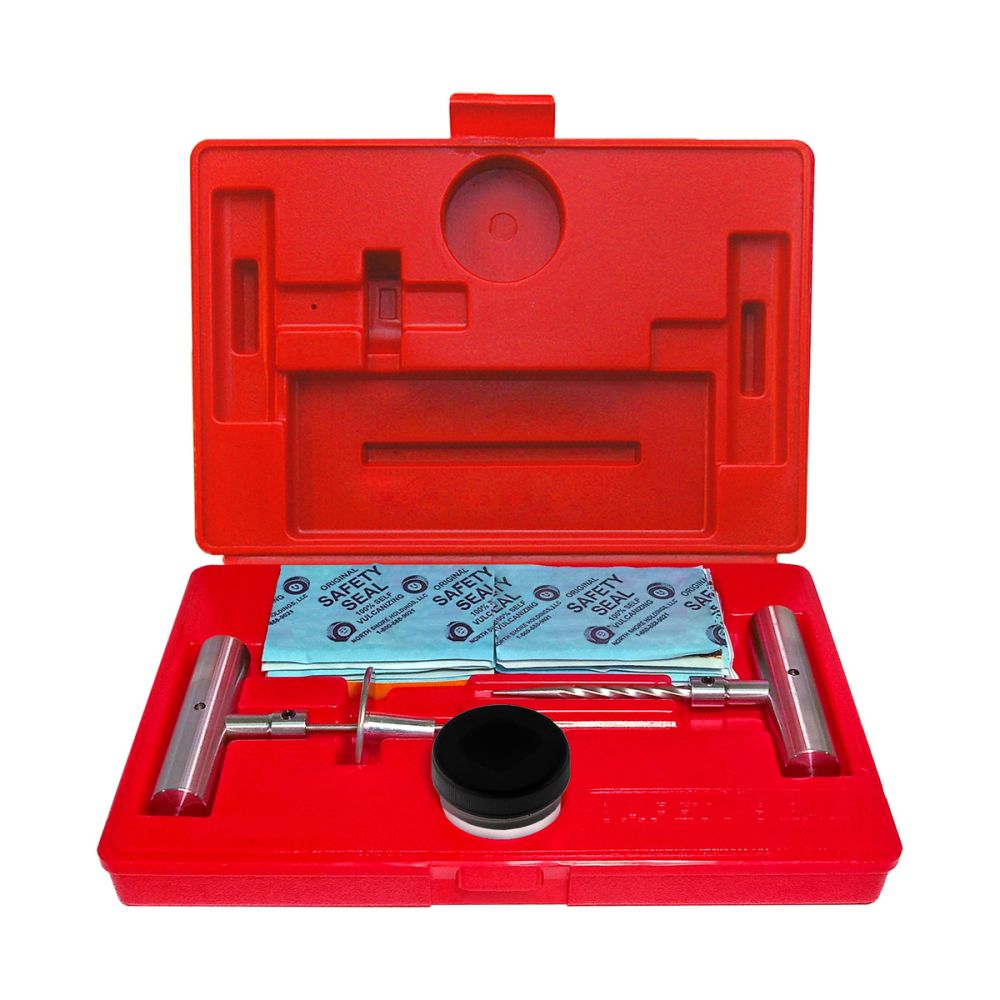

Features and benefits
- Repairs punctures up to 9 mm in diameter.
- (60) 102 mm repairs
- 127 mm Insertion tool
- 121 mm Spiral Probe
- Lube
- Instructions accessory pack with extra needle, razor blades, hex wrench, and set screw
- Professional repair solution for passenger and light truck tires.
Specifications
| Specifications | |
|---|---|
| Brand | Safety Seal |
| Net weight (kg) | 1.6 |
| Product dimensions - LxWxH (cm) | 30x20x8 |
Documents
FAQ
PLUG REPAIR FAQ
-
How long do they last in storage?
6–8 years, depending on storage conditions. -
Which repair insert do I use for each application?
RA – Standard auto or light truck tyres, for injuries up to 1/4”
RS – Standard auto or light truck tyres, for injuries up to 1/8”
RT – Over-the-road truck tyres
RHE – Agricultural and construction equipment. Not for high-speed use. Multiple inserts may be used. -
Is a plugged tyre considered a permanent repair?
No. A patch or a plug alone is not considered a permanent repair. -
Is a plug with liquid patch considered a permanent repair?
The Rubber Manufacturers Association considered it permanent in the 1990s. Not sure today, current standards may vary. -
Do I need to use vulcanising cement with a plug?
No, but some people choose to use it. -
Can I drill out the injury with a 1/4” drill bit?
Not recommended. Drilling may damage the tyre’s belt package. -
Can I burn the excess plug material after insertion?
No. Use a razor blade to trim off the excess material. -
What does “Self-Vulcanising”/ “Self-Vulcanised” mean?
These terms refer to rubber compounds that cure (vulcanise) on their own, without requiring external heat. “Self-Vulcanising” was the term originally used by the inventors.
Key benefits on vulcanised rubber:
Increased strength: More resistant to stress and deformation
Enhanced elasticity: Vulcanised rubber retains its shape and returns to its original form after stretching or compression.
Improved heat resistance: It can withstand higher temperatures without softening or degrading as easily as unvulcanised rubber.
Better solvent resistance: Vulcanised rubber swells less when exposed to solvents.
Improved abrasion resistance: It is more resistant to wear and tear from friction.
Review instruction manuals for each product.